
The Statistics Graduate Program at the University of Seoul
Entering graduate school
Even in the mid-1980s, elementary schools surveyed parents’ educational backgrounds. We had to submit written family records to teachers, including parents’ occupations and other details we might not have wanted to disclose. Some classmates’ parents were listed as having master’s degrees. When university education was less common, a master’s degree seemed particularly impressive. That was different from many people’s present image of graduate school and graduate students. Today it is easy to find self-deprecating accounts of graduate life; reading them makes me feel both sorry and bitter. I was a graduate student too.
Most people probably do not know how graduate students live or what they learn at a particular university. Even if they think they know, their picture may be of one lab in one discipline. So I would like to discuss graduate students in one lab at one university—my own—from a professor’s perspective, although I will also mention other graduate students in the department. This is not the whole story of graduate life, but I hope it helps people interested in machine learning and graduate study.
Master’s admissions
Preparation for admission to the University of Seoul statistics graduate program seems relatively straightforward. Interviewers focus on whether applicants have a solid undergraduate foundation in statistics and use a logical approach to explain a problem. Memorizing circulating past questions may conceal weaknesses briefly, but professors may probe the logic of an answer or ask deeper questions to establish the limits of the applicant’s knowledge. A coherent conceptual framework therefore seems more important than simply solving problems well.
Admission is not the end. Most incoming master’s students have some foundation in mathematical statistics and probability, and are likely to find mathematical knowledge essential for keeping up. It is therefore wise to review at least calculus and mathematical statistics before entering. Incoming students often seem less prepared in programming. Since programming is not taught separately in the first semester, differences in problem-solving ability can feel substantial. Interestingly, that gap can narrow more readily than expected. Although individual abilities differ, building programming skills seems to take less time than developing mathematical ability and individual differences may be somewhat smaller. This means that effort can develop programming ability in a relatively short time—not that it is easy.
First semester of the master’s program
In the first semester, students in the University of Seoul statistics graduate program study without being assigned to a research lab. Some may already have consulted a professor and participated in lab activities, but most can study before choosing a lab. Master’s students are given workspace and one PC each. I did not realize what a benefit dedicated research space was until I compared it with institutions abroad. Being able to work outside the library and ask nearby doctoral or senior master’s students about things you do not understand is a great environment. In fact, one learns a great deal by asking questions, especially in programming.
First-semester courses include mathematical statistics, probability, and applied statistics. As in most master’s programs, the workload is substantial. One reason to learn these subjects well is the thesis qualifying examination, which must be passed to graduate. Beyond the exam, the work done now can provide a strong theoretical foundation in statistics and machine learning for a long time. When else will you have such an opportunity to think through the logic in depth?
Summer vacation and the second semester
Summer vacation in the statistics graduate program is a time to prepare for the thesis qualifying exam, generally held near the end of August. Some students may object; personally I think it might be nice to shorten the period of suffering, though others may appreciate the additional study time. This is also when students are assigned to labs. Master’s students often do not really know what professors do, so the views of senior students may have an overwhelming influence, as they did for me. Professors without senior students in their labs may consequently attract fewer students, while those with many may find recruitment easier. If graduate school is simply a way to gain time while preparing for employment, any lab may be acceptable. But if you want experience for your résumé or particular skills and knowledge, you need to understand what the professor researches. Look at the professor’s papers, seminars, and projects, and make contact if something interests you.
At the University of Seoul, labs are run by individual professors, but graduate students share physical space. There are six modules in Mirae Hall, where the department office and professors’ offices are located, with about six people per module, and one in the adjacent Science and Technology Building. Together they accommodate around 40 people; almost all the space is currently assigned, with more planned. Students can use CPU and GPU resources at the university’s Urban Big Data and AI Institute, with immediate access on weekday evenings and weekends; the university plans further expansion. From the second semester, students may work as teaching assistants and receive help with tuition. Tuition is relatively low, so the amount is not large, but it helps. There may also be occasional opportunities to earn tuition by joining the university’s Digital Innovation Shared University undergraduate project. Some professors may provide research funding as well.
Once assigned to a lab, students will probably attend seminars with senior lab members. The advisor may attend, or senior students may lead, although professors seem to participate in most cases. You might enjoy the sense of belonging or think, ‘Leave me alone!’ I was closer to the former. One recent disappointment is not being able to meet at the university and freely have dinner together. When will COVID finally end?
In the second semester students take courses they want, although the small size of the statistics graduate program limits the choices. The courses become more specialized. Around this time projects in professors’ labs often begin, involving collaboration with experts in fields such as climate, transport, and population. Industry projects can also involve defense technology or analysis of diet effects, so the range of data-analysis experience is wide. Students often list these projects on their résumés. Around this time they also make an important decision: whether to pursue a PhD. Representative courses available from the second semester onward include:
- Multivariate Analysis: analysis and inference for multidimensional data.
- Machine Learning: an overview of machine learning.
- Optimization: optimization methods used in machine learning.
- Stochastic Optimization: methods and theory of stochastic optimization.
- Sampling Theory: the study of sampling.
- Time Series Analysis: time-series models and data analysis.
- Bayesian Inference: foundations of Bayesian methods.
- Advanced Statistical Programming: Python fundamentals and applications to computational statistics.
- Design of Experiments: optimal experimental design.
- Information Theory: an overview of information theory.
There are many reasons to pursue a PhD, but perhaps the most common is simply that it looks appealing. Someone considering one has probably been drawn to statistics and data science and believes life is about doing what one wants even if it means going a little hungry for a few years. I strongly support such people, perhaps because they think like me. (What else is life? Do what you want while making sure you can eat!) It is a somewhat risky idea, of course, but I do not intend to offer them life advice contrary to my own beliefs.
Second year of the master’s program
After the first year, students become somewhat accustomed to lab life and anxiety gradually sets in. New students without assigned advisors appear in the same space and keep asking questions, which may only increase that anxiety. Students may also reflect on what they gained from lab seminars. One question worth asking is what use the papers read and presentations prepared have ultimately been, and how useful superficially collected knowledge really is. I try to discuss how students can turn their accumulated knowledge into outputs, but many second-year master’s students may have produced nothing yet. This should be a time to create results: organize a blog, produce a paper, complete and release a program in one’s own words, or enter a competition.
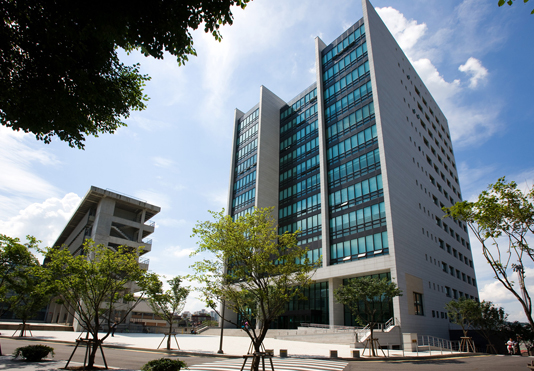 A view of Mirae Hall, University of Seoul
Writing down how I see graduate students’ lives brings back memories. I was once a graduate student too, with similar worries, preparing hard for tomorrow despite my anxiety. That is why I support them all the more. I cheer on our graduate students as they work toward a better tomorrow!
Afterword
Since 2021, the University of Seoul statistics graduate program has undertaken major education and research-support projects. Most students receive scholarship support and a variety of educational opportunities. A distinctive feature is its well-designed curriculum spanning sampling theory, mathematical statistics, machine learning and AI, databases, and visualization, enabling students to develop expertise connecting statistical and computing foundations to applications. Being in the sciences also gives students the opportunity to participate in graduate labs and use large-scale computing resources. We welcome everyone who joins the University of Seoul statistics graduate program!